


Details
DRM: Digitales Wasserzeichen
Weitere Details
1. Auflage 2014
03.09.2014
English
2.90 MB
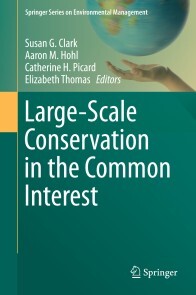
Large-Scale Conservation in the Common Interest
eBook - Earth and Environmental Science (R0)
Beschreibung
Über Susan G Clark, Aaron M Hohl, Catherine H Picard
Susan Clark¿s primary goal in her research and teaching is to improve conservation of species and ecosystems at professional, scientific, organizational and policy levels. In addition to ecological and behavioral field research on thirty-five mammals and other species, she has conducted research and applied projects in North America, Australia, Asia and Central America, building case studies, evaluating policies and programs, helping organizations to incorporate reliable science into management, helping students to develop proficiency in the policy sciences method of problem solving and working with a wide range of groups to improve conservation problem solving through workshops and other analytic exercises. Recent books include Large Carnivore Conservation: Integrating Science and Policy in the North American West (2014), The Policy Process: A Practical Guide for Natural Resource Professionals (2002) and Foundations of Natural Resources Policy and Management (2000). She is a professor (adjunct) at the Yale School of Forestry and Environmental Studies.
Aaron Hohl holds a Ph.D. in forestry and environmental studies from Yale University, a M.E.M. in landscape ecology from Duke University and a B.S. in biology and philosophy from John Carroll University. He has worked as an agroforestry extension agent and technical trainer for the U.S. Peace Corps in Paraguay, a forest ecologist for the Forest Service¿s Southern Global Change Program, and a natural resource consultant to both governmental and non-governmental organizations. His research has taken him from the mixed hardwood forests of North Carolina¿s Appalachian Mountains to the radioactive pine forests of the Chernobyl Exclusion Zone. He is an ARB-accredited lead verifier for forest carbon offset projects. He is currently a lecturer in the Department of Forestry and Wildland Resources at Humboldt State University, where he has taught courses in forest management, forest mensuration andenvironmental economics.
Catherine Picard is based in Burlington, Vermont, where she is an environment and natural resources associate with Tetra Tech/Associates in Rural Development. The daughter of a foreign service officer, she has lived and worked throughout sub Saharan Africa and developed a passion early on for international natural resource conservation and development. Prior to joining Tetra Tech, Catherine served for three years with the U.S. State Department¿s Bureau of African Affairs, where she focused on the intersection of conflict and natural resources, including conflict diamonds and minerals and the transboundary management of the Nile Basin. Before that, she spent five years in Chicago with the MacArthur Foundation as the director of administration and a program officer for cross cutting grants in international conservation and development. Dr. Picard holds a Ph.D. from Yale University as well as master¿s and undergraduate degrees from University of Michigan and the University of California at Berkeley, respectively.
Elizabeth Thomas is based in Denver, Colorado, where she works with governments, communities and non-profits on the interplay between conservation, land use decisions and people. She has worked as a corporate sustainability analyst consulting with Fortune 500 companies and as an ecological field researcher in the Eastern Sierra of California. She holds a master¿s degree in environmental science from the Yale School of Forestry and Environmental Studies and an undergraduate degree in environment, economics and politics from Claremont McKenna College.
Inhalt
E-Book Informationen
Alle hier erworbenen E-Books können Sie in Ihrem Kundenkonto in die kostenlose PocketBook Cloud laden. Dadurch haben Sie den Vorteil, dass Sie von Ihrem PocketBook E-Reader, Ihrem Smartphone, Tablet und PC jederzeit auf Ihre gekauften und bereits vorhandenen E-Books Zugriff haben.
Um die PocketBook Cloud zu aktivieren, loggen Sie sich bitte in Ihrem Kundenkonto ein und gehen dort in den Bereich „E-Books“. Setzen Sie hier einen Haken bei „Neue E-Book-Käufe automatisch zu meiner Cloud hinzufügen.“. Dadurch wird ein PocketBook Cloud Konto für Sie angelegt. Die Zugangsdaten sind dabei dieselben wie die Ihres Kundenkontos in diesem Webshop.
Weitere Informationen zur PocketBook Cloud finden Sie unter www.meinpocketbook.de.
Allgemeine E-Book-Informationen
E-Books in diesem Webshop können in den Dateiformaten EPUB und PDF vorliegen und können ggf. mit einem Kopierschutz versehen sein. Sie finden die entsprechenden Informationen in der Detailansicht des jeweiligen Titels.
E-Books ohne Kopierschutz oder mit einem digitalen Wasserzeichen können Sie problemlos auf Ihr Gerät übertragen. Sie müssen lediglich die Kompatibilität mit Ihrem Gerät prüfen.
Bei E-Books die mit Readium LCP geschützt sind erscheint bei dem ersten Öffnen auf ihrem Reader ein Hinweisfenster mit der Aufforderung ein Passwort einzugeben. Gleichzeitig öffnet sich ein Infofeld in dem das Passwort steht. Tragen Sie dieses Passwort in das Eingabefeld ein und bestätigen Sie die Eingabe. Danach öffnet sich das E-Book automatisch. Um E-Books die mit Readium LCP geschützt sind auf einem Tablet/Laptop/Smartphone lesen zu können, benötigen Sie ein Programm, das in der Lage ist, mit diesem Kopierschutz umzugehen. Das ist z.B. der Thorium Reader (Windows, Mac, Linux) oder die PocketBook App (iOS, Android). Fügen Sie das heruntergeladene E-Book in das Programm ein. Bei dem ersten Öffnen erscheint ein Hinweisfenster mit der Aufforderung ein Passwort einzugeben. Gleichzeitig öffnet sich ein Infofeld in dem das Passwort steht. Tragen Sie dieses Passwort in das Eingabefeld ein und bestätigen Sie die Eingabe. Danach öffnet sich das E-Book automatisch.
Um E-Books, die mit Adobe DRM geschützt sind, auf Ihr Lesegerät zu übertragen, benötigen Sie zusätzlich eine Adobe ID und die kostenlose Software Adobe® Digital Editions, wo Sie Ihre Adobe ID hinterlegen müssen. Beim Herunterladen eines mit Adobe DRM geschützten E-Books erhalten Sie zunächst eine .acsm-Datei, die Sie in Adobe® Digital Editions öffnen müssen. Durch diesen Prozess wird das E-Book mit Ihrer Adobe-ID verknüpft und in Adobe® Digital Editions geöffnet.


