


Details
DRM: Digitales Wasserzeichen
Weitere Details
1. Auflage 2012
15.07.2012
English
204 S., 5.01 MB
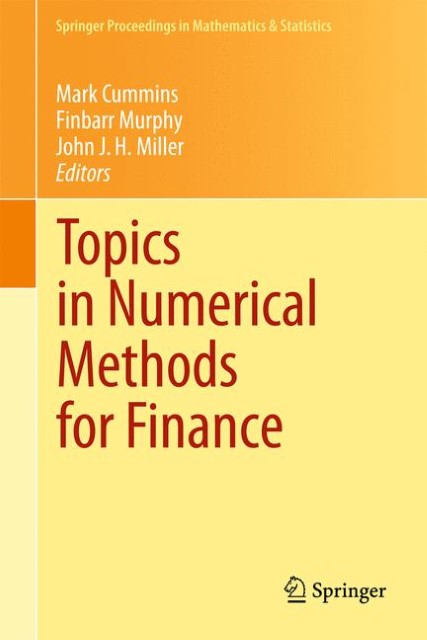
Topics in Numerical Methods for Finance
eBook - Springer Nature Proceedings excluding Computer Science
Beschreibung
Presenting state-of-the-art methods in the area, the book begins with a presentation of weak discrete time approximations of jump-diffusion stochastic differential equations for derivatives pricing and risk measurement. Using a moving least squares reconstruction, a numerical approach is then developed that allows for the construction of arbitrage-free surfaces. Free boundary problems are considered next, with particular focus on stochastic impulse control problems that arise when the cost of control includes a fixed cost, common in financial applications. The text proceeds with the development of a fear index based on equity option surfaces, allowing for the measurement of overall fear levels in the market. The problem of American option pricing is considered next, applying simulation methods combined with regression techniques and discussing convergence properties. Changing focus to integral transform methods, a variety of option pricing problems are considered. The COS method is practically applied for the pricing of options under uncertain volatility, a method developed by the authors that relies on the dynamic programming principle and Fourier cosine series expansions. Efficient approximation methods are next developed for the application of the fast Fourier transform for option pricing under multifactor affine models with stochastic volatility and jumps. Following this, fast and accurate pricing techniques are showcased for the pricing of credit derivative contracts with discrete monitoring based on the Wiener-Hopf factorisation. With an energy theme, a recombining pentanomial lattice is developed for the pricing of gas swing contracts under regime switching dynamics. The book concludes with a linear and nonlinear review of the arbitrage-free parity theory for the CDS and bond markets.
Über Mark Cummins, Finbarr Murphy, John J H Miller
Mark Cummins is a Lecturer in Finance at the Dublin City University Business School. He holds a PhD in Quantitative Finance, with specialism in the application of integral transforms and the fast Fourier transform (FFT) for derivatives valuation and risk management. Mark has previous industry experience working as a Quantitative Analyst within the Global Risk function for BP Oil International Ltd., London. Mark has a keen interest in a broad range of energy modelling, derivatives, risk management and trading topics. He also has a growing interest in the area of sustainable energy finance, with particular focus on the carbon markets. Linked to Mark's industry experience, he holds a further interest in the area of model risk and model validation.
Finbarr Murphy is a Lecturer in Quantitative Finance at the University of Limerick, Ireland. Finbarr's key teaching and research interests lie in the field of credit risk and derivatives and more recently, in carbon finance. His research is focused on the application of generalised Lévy Processes and their application in the pricing and risk management of derivative products. Finbarr is also interested in the application of econometric techniques in finance. Prior to taking up his position in UL, Finbarr was a Vice President of Convertible Bond Trading with Merrill Lynch London.
John J.H. Miller is Director of INCA, the Institute for Numerical Computation and Analysis, in Dublin, Ireland. He is also a Fellow Emeritus of Trinity College, Dublin, where he was a member of the Mathematics Department. He received his Sc.D. from the University of Dublin and his Ph.D. in numerical analysis from the Massachusetts Institute of Technology. He completed his undergraduate degrees at Trinity College Dublin.
Inhalt
E-Book Informationen
Alle hier erworbenen E-Books können Sie in Ihrem Kundenkonto in die kostenlose PocketBook Cloud laden. Dadurch haben Sie den Vorteil, dass Sie von Ihrem PocketBook E-Reader, Ihrem Smartphone, Tablet und PC jederzeit auf Ihre gekauften und bereits vorhandenen E-Books Zugriff haben.
Um die PocketBook Cloud zu aktivieren, loggen Sie sich bitte in Ihrem Kundenkonto ein und gehen dort in den Bereich „E-Books“. Setzen Sie hier einen Haken bei „Neue E-Book-Käufe automatisch zu meiner Cloud hinzufügen.“. Dadurch wird ein PocketBook Cloud Konto für Sie angelegt. Die Zugangsdaten sind dabei dieselben wie die Ihres Kundenkontos in diesem Webshop.
Weitere Informationen zur PocketBook Cloud finden Sie unter www.meinpocketbook.de.
Allgemeine E-Book-Informationen
E-Books in diesem Webshop können in den Dateiformaten EPUB und PDF vorliegen und können ggf. mit einem Kopierschutz versehen sein. Sie finden die entsprechenden Informationen in der Detailansicht des jeweiligen Titels.
E-Books ohne Kopierschutz oder mit einem digitalen Wasserzeichen können Sie problemlos auf Ihr Gerät übertragen. Sie müssen lediglich die Kompatibilität mit Ihrem Gerät prüfen.
Bei E-Books die mit Readium LCP geschützt sind erscheint bei dem ersten Öffnen auf ihrem Reader ein Hinweisfenster mit der Aufforderung ein Passwort einzugeben. Gleichzeitig öffnet sich ein Infofeld in dem das Passwort steht. Tragen Sie dieses Passwort in das Eingabefeld ein und bestätigen Sie die Eingabe. Danach öffnet sich das E-Book automatisch. Um E-Books die mit Readium LCP geschützt sind auf einem Tablet/Laptop/Smartphone lesen zu können, benötigen Sie ein Programm, das in der Lage ist, mit diesem Kopierschutz umzugehen. Das ist z.B. der Thorium Reader (Windows, Mac, Linux) oder die PocketBook App (iOS, Android). Fügen Sie das heruntergeladene E-Book in das Programm ein. Bei dem ersten Öffnen erscheint ein Hinweisfenster mit der Aufforderung ein Passwort einzugeben. Gleichzeitig öffnet sich ein Infofeld in dem das Passwort steht. Tragen Sie dieses Passwort in das Eingabefeld ein und bestätigen Sie die Eingabe. Danach öffnet sich das E-Book automatisch.
Um E-Books, die mit Adobe DRM geschützt sind, auf Ihr Lesegerät zu übertragen, benötigen Sie zusätzlich eine Adobe ID und die kostenlose Software Adobe® Digital Editions, wo Sie Ihre Adobe ID hinterlegen müssen. Beim Herunterladen eines mit Adobe DRM geschützten E-Books erhalten Sie zunächst eine .acsm-Datei, die Sie in Adobe® Digital Editions öffnen müssen. Durch diesen Prozess wird das E-Book mit Ihrer Adobe-ID verknüpft und in Adobe® Digital Editions geöffnet.